
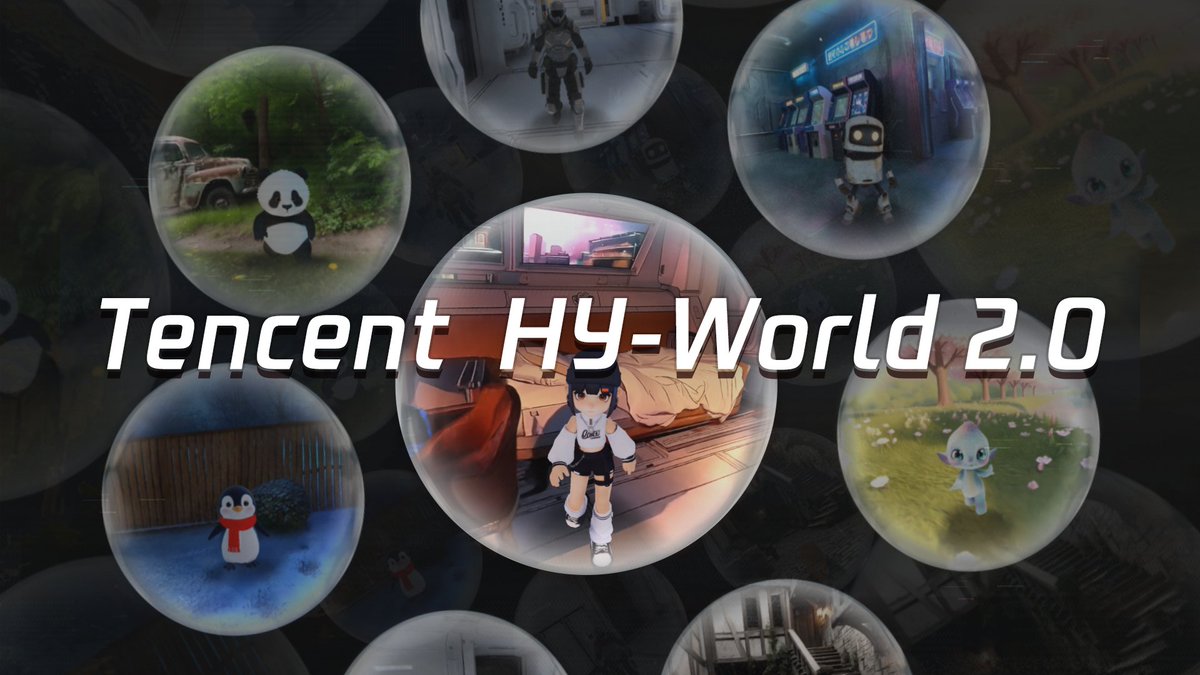
What is HY-World 2.0?
HY-World 2.0 is Tencent Hunyuan's multimodal world model for reconstructing, generating and simulating 3D worlds. It is the biggest departure from the rest of this list: instead of generating video that disappears when the session ends, it outputs persistent 3D assets — meshes, 3D Gaussian Splats and point clouds — that you can import straight into Unity, Unreal Engine, Isaac Sim or Blender. Tencent frames it as building a playable world rather than watching a movie that ends.
How the pipeline works
A four-stage pipeline turns a single image or text prompt into a navigable 3D world: HY-Pano 2.0 generates a 360° panorama, WorldNav plans camera trajectories through it, WorldStereo 2.0 expands the world with consistent new views, and WorldMirror 2.0 composes everything into 3D.
WorldMirror 2.0 also works the other way: feed it a video or a set of photos and it reconstructs depth, camera poses and Gaussian-splat attributes in one pass.
Why 3D output matters
Video world models pay inference cost on every frame you watch, and their consistency fades over time. A 3D world is generated once, then rendered at near-zero cost on consumer GPUs, with exact control, real collision physics and accurate lighting — and it never forgets what is behind you. HY-World 2.0 supports first- and third-person exploration with physics-aware collision, so movement respects the geometry instead of clipping through it. It is already used in Tencent's internal game pipeline and has been adopted by Maxon for Cinema 4D.
How it relates to WorldPlay
HY-World 2.0 builds on HY-World 1.5, also known as WorldPlay, which Tencent released in December 2025 as an open real-time video world model streaming at 24 FPS and 720p. Tencent's newest interactive model in that line is Hy-Nomas.
Strengths and limitations
Strengths
- Persistent, editable 3D assets
- Imports directly into major game engines
- Physics-aware first- and third-person exploration
- Open source; also reconstructs real scenes from video or photos
Limitations
- Not a live, real-time generative world
- Multi-stage pipeline; some components are very large
- Static environments rather than evolving scenes with characters
Who is HY-World 2.0 for?
Game developers, 3D artists and simulation teams who want AI-generated worlds as real, reusable 3D assets rather than video.
Frequently asked questions
What file formats does HY-World 2.0 produce?
Meshes, 3D Gaussian Splats and point clouds, ready for Unity, Unreal Engine, Isaac Sim or Blender.
Is HY-World 2.0 open source?
Yes. Tencent released it on GitHub and Hugging Face.
Is HY-World 2.0 a real-time world model?
No. It generates 3D worlds once, which can then be explored in real time in a game engine. Tencent's real-time video world models are WorldPlay and Hy-Nomas.
Can HY-World 2.0 reconstruct a real place?
Yes. WorldMirror 2.0 reconstructs depth, camera poses and Gaussian splats from a video or multi-view photos.