
![Best AI World Models [2026]: Where to Play Immersive Text-to-World AIs & Leaderboard](/scenario_covers/scenario_40_1760420927.jpg)
The world of AI is evolving rapidly, and the last year has brought us closer than ever to interactive virtual worlds that feel alive. AI world models—systems that can generate explorable, responsive environments in real-time—are no longer science fiction. They're here, and they're playable.
This guide will walk you through the best AI world models available today. From Robbyant's hour-long LingBot-World 2.0 to Google's groundbreaking Genie 3 and a wave of open-source challengers pushing the boundaries of what's possible, we've ranked them all.
🌍 Try World Simulator AI
Before we dive into the leaderboard, experience interactive AI worlds powered by our own AI video model. Create immersive first-person adventures.
Start Playing NowThe AI World Models Leaderboard
We've evaluated each platform based on interactivity, visual quality, accessibility, real-time performance, and overall innovation. Here's our definitive ranking:

Genie 3
Genie 3 generates fully interactive 3D environments at 720p resolution and 24 FPS from simple text prompts. What sets it apart is its ability to maintain visual and physical consistency for minutes at a time, with objects remaining exactly where you left them even after exploring other areas.
Key Innovation: Unlike traditional game engines, Genie 3 learns physics and world dynamics from observation rather than hardcoded rules. This allows it to generate diverse environments—from photorealistic volcanic landscapes to whimsical animated worlds—all maintaining realistic physics.
Current Status: Limited research preview. Available only to select academics and creators as Google continues refining safety measures and capabilities.
Learn More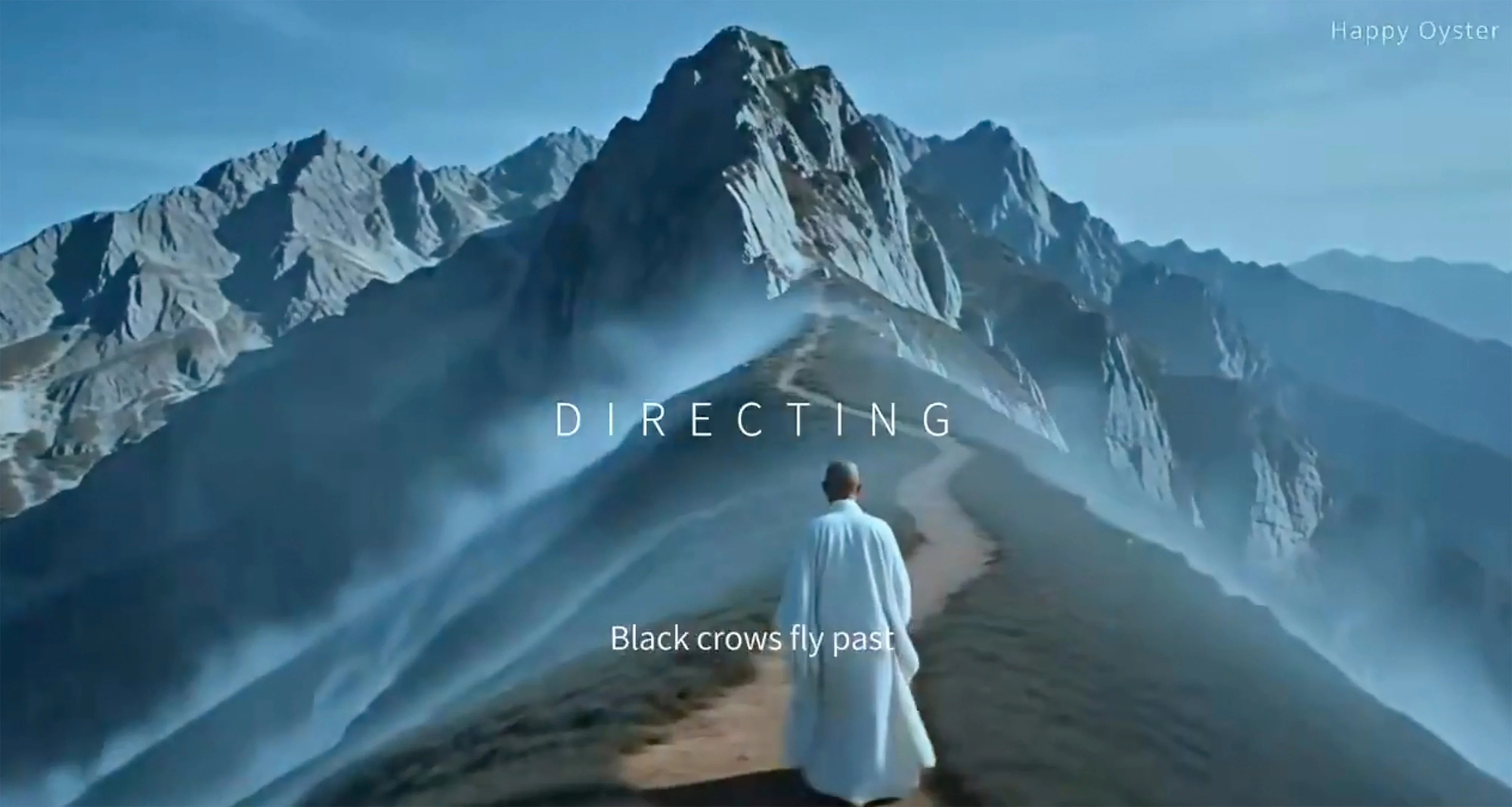
Happy Oyster
Alibaba's answer to Genie 3, and the only other closed model in this list that feels like a finished product rather than a research preview. Happy Oyster does not hand back a rendered clip — it generates the world while you steer it, taking text, voice, image and keyboard input and producing picture and sound together in one continuous stream.
Two Modes: Directing lets you steer a running scene for up to three minutes, changing camera angles, redirecting characters or altering the story mid-generation. Wandering drops you into first person with standard WASD and camera controls, and the world keeps extending as you walk — up to a minute per session.
Sound Is Not Bolted On: Most world models treat audio as post-production. Happy Oyster generates visual and auditory signals inside the same world state, so the two are aligned by construction rather than synchronised afterwards. It is a small distinction that matters a great deal once you are actually inside a scene.
Where It Wins And Loses: Independent benchmarking puts Happy Oyster near the top for subject memory in third person and for interaction physics in first person — characters stay themselves, objects behave. Its weaker area is action-following, where the strongest open models still beat it. The session limits also place it closer to prototyping and storyboarding than to finished production.
Current Status: Early access through a waitlist, with API availability through fal. It comes from the same Alibaba team behind HappyHorse-1.0, which topped the Artificial Analysis video leaderboards before Alibaba confirmed ownership.
Try Happy Oyster Play on fal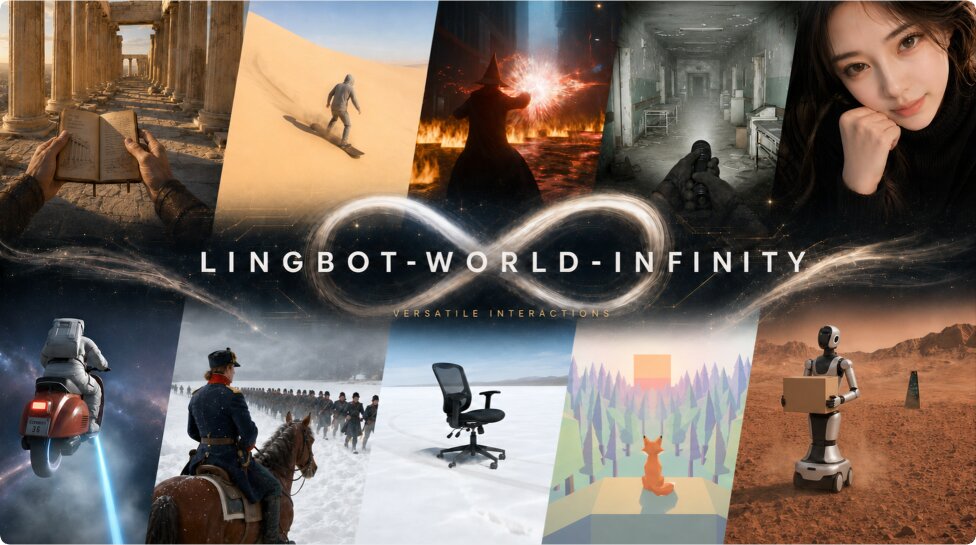
LingBot-World 2.0 (Infinity)
The newest entrant tops the list by solving the problem every other world model has struggled with: time. LingBot-World 2.0, open-sourced by Robbyant — an embodied-AI company within Ant Group — generates fully interactive worlds from a single image and keeps them coherent for an hour or more, at a stable 720p and 60 FPS, with no quality decay.
Key Innovation: LingBot-World 2.0 is built on a causal pretraining paradigm paired with a proprietary attention-masking mechanism the team calls MoBA, which lets the model learn how a world evolves in chronological order. That's what keeps the "unbounded interaction horizon" from degrading into the drift and texture decay that shorter-memory world models eventually hit.
Rich Action Space: Beyond walking and looking around, characters can attack, shoot arrows, cast spells, jump, and glide, with outcomes generated dynamically to stay physically plausible. Typed commands can also trigger global events — day-night cycles, weather changes, new entities dropped into the scene.
Dual-Agent Mechanism: A built-in "Pilot" agent plans and executes character behavior, while a "Director" agent introduces new events as the scene unfolds — pushing worlds from merely watchable and controllable toward what Robbyant calls "sustainably interactive and dynamically evolving." The model also supports multiple users inside a single persistent world, a first for this category.
Current Status: Fully open-sourced on GitHub alongside a companion release, LingBot-Video, and playable today through partners like Reactor.
Try on Reactor View on GitHub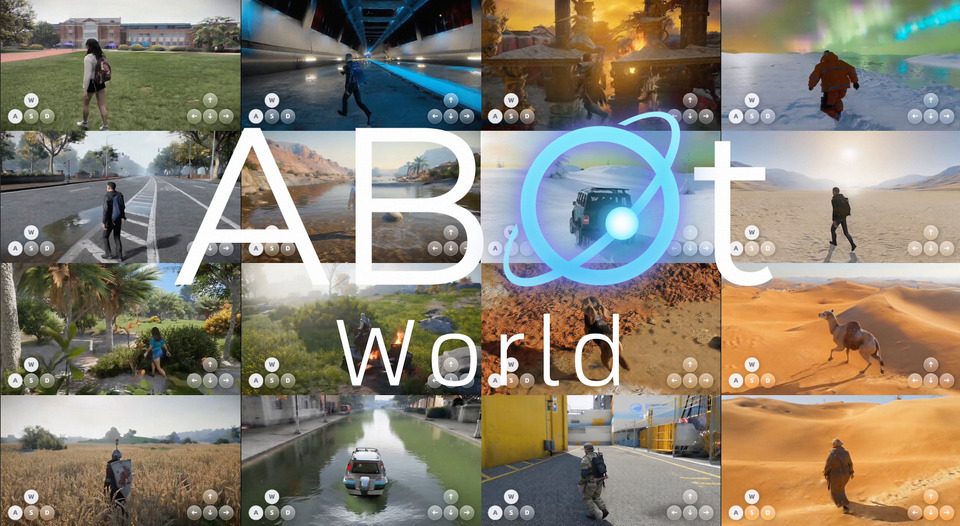
ABot-World-0
The one you can actually run yourself. ABot-World-0 is a 5-billion-parameter open model that streams an interactive world at 720p and up to 16 frames per second from a single desktop graphics card — an RTX 5090, using under 19 GB of video memory. Everything else at this level of quality needs a cluster.
Why The Hardware Matters: A world model that needs rented compute is a demo. One that runs on a machine you own is a tool. ABot-World-0 gets there by co-designing the whole inference path — a lightweight decoder, efficient attention, memory-aware scheduling and low-bit computation — rather than by shrinking the model until it stops being interesting.
Infinite Rollout: The team's LongForcing training aligns long self-generated sequences with an extended-horizon teacher, which is their answer to the drift that accumulates when a model keeps feeding on its own output. In practice the world keeps expanding with new scenes instead of locking into the one it started with, and without needing a prompt change to do it.
Genuinely Open: Apache 2.0, which permits commercial use without the bespoke licence review that other model families require. The weights, the inference code and a 500-hour annotated training dataset are all public.
Current Status: Released July 2026 with weights on Hugging Face and code on GitHub. There is a hosted demo you can try in the browser without installing anything.
Play in your browser View on GitHub
Odyssey-3
Odyssey's most ambitious model yet, and a bet that one world model can do far more than generate video. Unveiled in mid-September 2026, Odyssey-3 is an autoregressive diffusion transformer trained on a vast collection of visual observations of the world, and pitched as a single foundation model for physical AI: the same pretrained model powers robot arms, humanoids, cars and drones, trains other AIs, and can even play video games.
Key Innovation: Instead of training a separate system for every machine, Odyssey-3 draws on a shared, learned understanding of physics, motion and cause-and-effect. That knowledge makes new skills cheap to teach: according to Odyssey, it learned simulated driving from roughly 20 hours of data, and humanoid policies from just a few dozen hours of demonstrations. In tests with humanoid specialist Flexion — opening containers, moving and placing objects — it generalized better than the VLA baselines it was compared against, and kept working under lighting changes that broke them.
Still A World Model: At its core Odyssey-3 generates the world frame by frame, just like the interactive video that made its predecessor Odyssey-2 famous. It can simulate interactive environments where people and AI agents act and see the consequences — the decision-making for robots and vehicles is a policy layer trained on top of it.
Current Status: Not released yet — Odyssey plans public availability in the coming weeks. No speed, latency or hardware figures have been published so far, and all results come from the company's own testing.
Meet Odyssey-3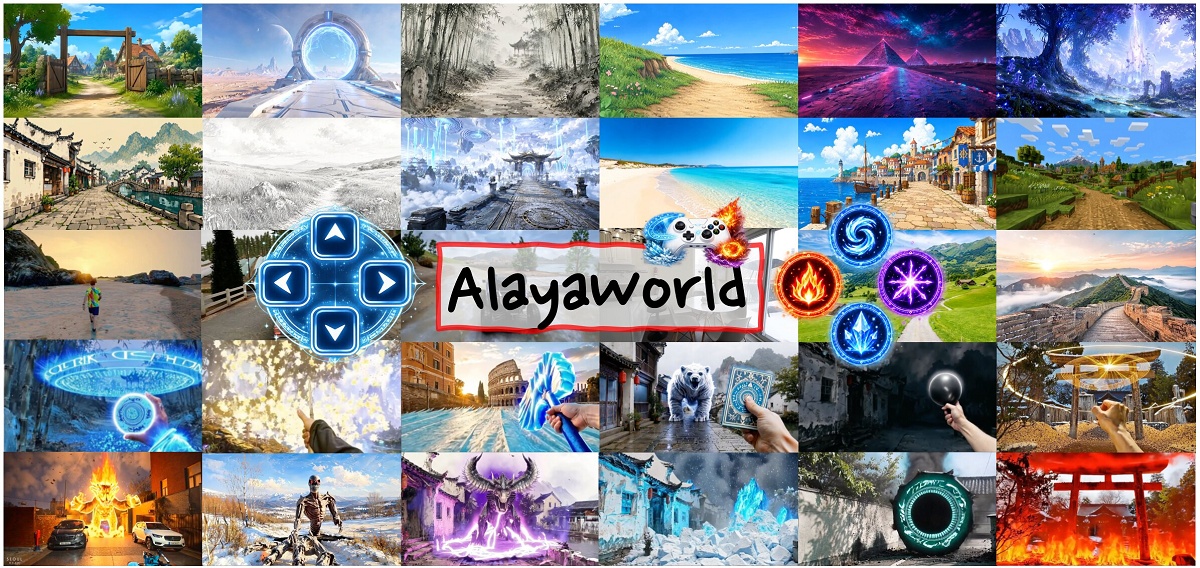
AlayaWorld (+ Alaya-EVOKE)
A full-stack open-source world model built around one priority: remembering where you have already been. AlayaWorld is a 15-billion-parameter video model that streams a world at 24 FPS in 540p or 720p, steered by camera movement and by text prompts you can swap mid-session to trigger new events.
How It Remembers: Rather than leaning only on the last few frames, every chunk is conditioned on a fixed anchor frame, a compressed summary of older history, a 3D point cache of the scene rendered from the current viewpoint, and the most recent frames. Walk out of a room and come back, and the layout, textures and objects are where you left them. Drift is tackled during training, by showing the model deliberately corrupted histories and an "error bank" of its own past artifacts.
Two Names, One Family: AlayaWorld is the base model. Alaya-EVOKE is a follow-up built on top of it that moves scene geometry into an external, camera-indexed world-state bank. Its authors report continuous 65.5-minute sessions without visible drift, generating 1.5-second chunks in roughly 2.1 seconds on a single H200 at 384×640 — a little slower than real time, and on top-tier hardware.
Where It Falls Short: By the team's own benchmark, AlayaWorld leads on consistency but is weaker on physical interaction and causal fidelity. It remembers places far better than it tracks what characters are doing — and at 15B parameters it is a data-center model, not a desktop one.
Current Status: Code, weights and training scripts are public, along with a live browser demo where you drive the camera from the keyboard and change the prompt while the world is being generated.
View on GitHub Read the paper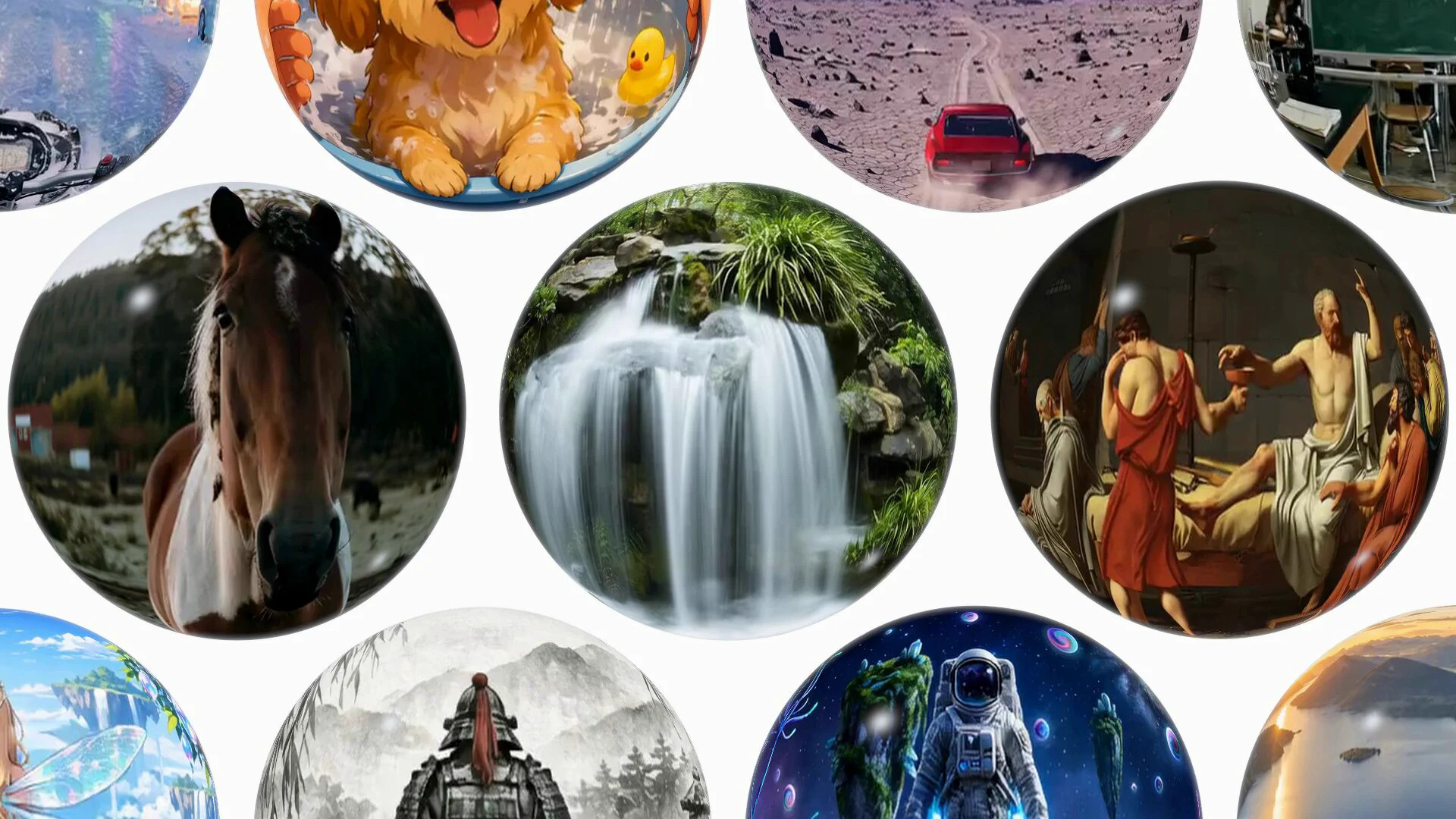
WorldCrafter
Tencent's research answer to the "look away and it's gone" problem. WorldCrafter turns a single image or text prompt into a world you explore by moving the camera, and it is designed so that places you have already seen come back the way you left them.
Key Innovation: A memory the camera can ask questions of. Instead of pushing every past frame into the generator, a memory encoder compresses earlier views, and a readout module keyed to the requested camera pose pulls out only what matters for the shot being generated. There are no explicit depth maps or geometric warping — the memory is learned together with the video model, and it works for dynamic scenes as well as static ones.
Performance: A few-step distilled "fast" version reaches 16 FPS, but on a four-GPU machine, which puts it firmly in cloud and research territory rather than on a home PC. In the paper it holds long-horizon consistency and camera accuracy clearly better than baselines over minute-scale exploration.
Current Status: Published in September 2026, with code on GitHub and a community demo on Hugging Face. Check the licence before any commercial use.
Project page View on GitHub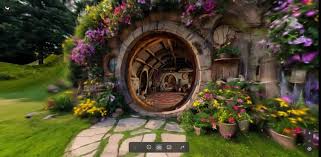
World Labs (Marble / Atlas)
Marble takes a different approach: instead of real-time generation, it creates persistent, downloadable 3D environments from text, images, videos, or even 360° panoramas. Think of it as a professional content creation tool rather than a real-time game engine.
What Makes It Special: Marble's "Chisel" feature lets you directly manipulate 3D structures before AI fills in visual details—like sketching the layout of a building, then watching AI render it realistically. You can also expand worlds, combine multiple environments, and export as Gaussian splats, meshes, or video.
Use Cases: Game development, VFX for film, virtual reality, and robotics simulation. Several studios are already using Marble to accelerate production pipelines and create realistic training environments for AI agents.
New — Atlas: Announced on September 1, 2026, Atlas is World Labs' "omni" world model, trained from scratch on text, images, video and 3D in one shared spatial context. Camera paths are a native input rather than something you describe in words, so you direct the shot instead of prompting for it: from one or a few reference images it generates up to a minute of 1440p video along a hand-designed trajectory, and it can also rebuild explicit 3D from one to dozens of photos. In World Labs' own tests, human raters preferred its camera control over rival video models in 75–94% of comparisons.
Current Status: Marble is publicly available. Atlas is not interactive in real time and is currently in early access for selected partners only.
Try Marble Meet Atlas
GWM Worlds 2
Runway's second-generation world model turns its audio-video generator into a live, playable simulation. Released as a research preview on September 3, 2026, GWM Worlds 2 streams continuous 720p video at 24 FPS together with generated 48 kHz audio, and keeps going for as long as you play — sessions have no preset length.
Key Innovation — WorldPrompt: Runway splits a world into what persists and what changes. The persistent layer describes the scene (layout, materials, lighting, ambient sound), the characters and their attributes, and the laws that govern them, from gravity to character abilities and camera perspective. On top of it runs a timestamped stream of free-form text actions, each addressed to a specific character or to the scene itself: a sword slash, a line of dialogue, a campfire flaring, a room flooding with water. Actions can overlap, so two characters can hold a conversation while the weather changes around them.
How You Play: First- or third-person navigation — walking, driving, riding — with camera and character controlled independently. In the demo, keys and mouse buttons are bound to ready-made action prompts, and an LLM assistant can build a whole world, from first frame to key bindings, out of a one-line idea. Several people can join the same session with different roles, one player per character plus a "director" who reshapes the world, and AI agents can take the controls too, making it usable as a training ground for agents.
Limitations: Real-time generation still trades fidelity for speed, very fast camera turns can degrade textures and geometry, and long-term memory is imperfect. Runway itself notes that getting the most out of text control may require an external system that tracks the state of the world and generates actions on the fly.
Current Status: Research preview with access by request. Not open source. It succeeds GWM-1 Worlds, Runway's first real-time world model from December 2025.
Meet GWM Worlds 2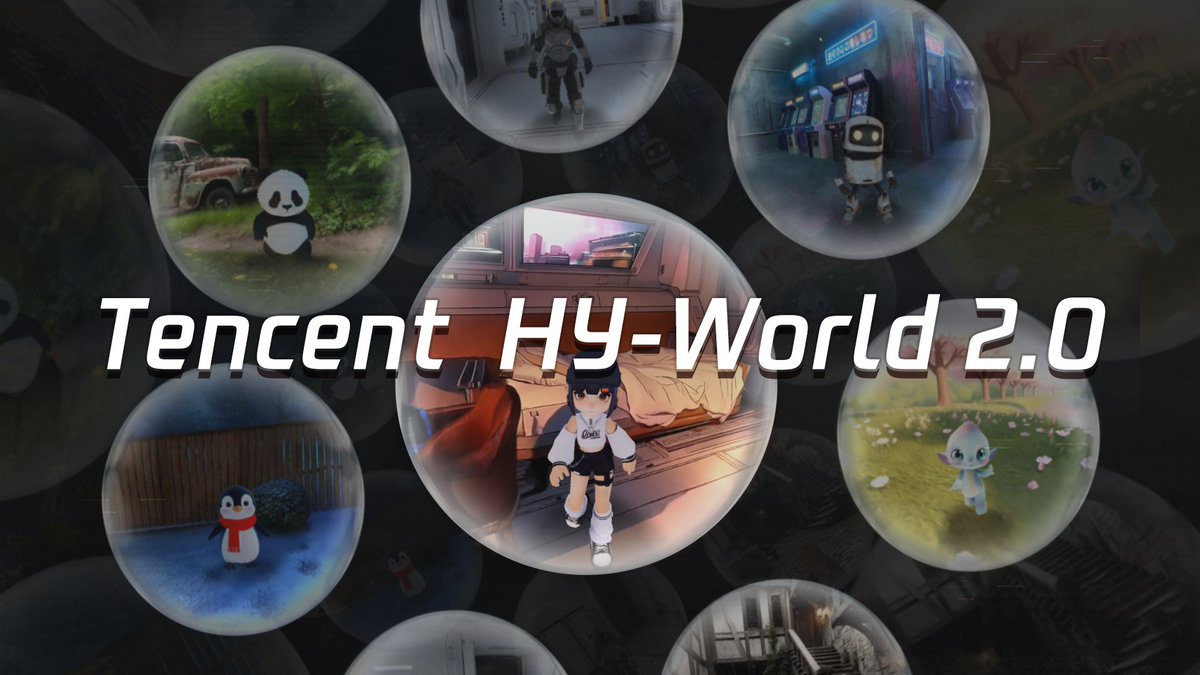
HY-World 2.0
Tencent's biggest departure from the rest of this list: instead of generating disposable video, HY-World 2.0 outputs real, persistent 3D assets — meshes, 3D Gaussian Splats, and point clouds — that drop straight into Unity, Unreal Engine, or Isaac Sim. The team frames it as "building a playable world" rather than "watching a movie that ends."
Technical Breakthrough: A four-stage pipeline — HY-Pano 2.0 for 360° panorama generation, WorldNav for trajectory planning, WorldStereo 2.0 for consistent view expansion, and WorldMirror 2.0 for 3D reconstruction — turns a single image or text prompt into a navigable 3D world. WorldMirror 2.0 also works the other way: feed it a video or multi-view photos and it reconstructs depth, camera pose, and 3DGS attributes in one pass.
Unique Features: Supports first-person and third-person exploration with physics-aware collision, so movement respects the geometry instead of clipping through it. Already integrated into Tencent's internal game pipeline and adopted by Maxon for Cinema 4D.
Developer-Friendly: Fully open-sourced on GitHub and Hugging Face, building on the earlier HY-World 1.5 (WorldPlay) release.
Learn More View on GitHubQuick Comparison
Best for long, persistent sessions: LingBot-World 2.0
Best for research: Genie 3
Best open-source memory research: AlayaWorld / WorldCrafter
Best for interactive storytelling: GWM Worlds 2
Best for local-first privacy: Overworld (Waypoint-1.5 / Waypoint 2)
Best for engine-ready 3D output: HY-World 2.0
Best for content creators: World Labs (Marble / Atlas)
Best to watch for physical AI: Odyssey-3
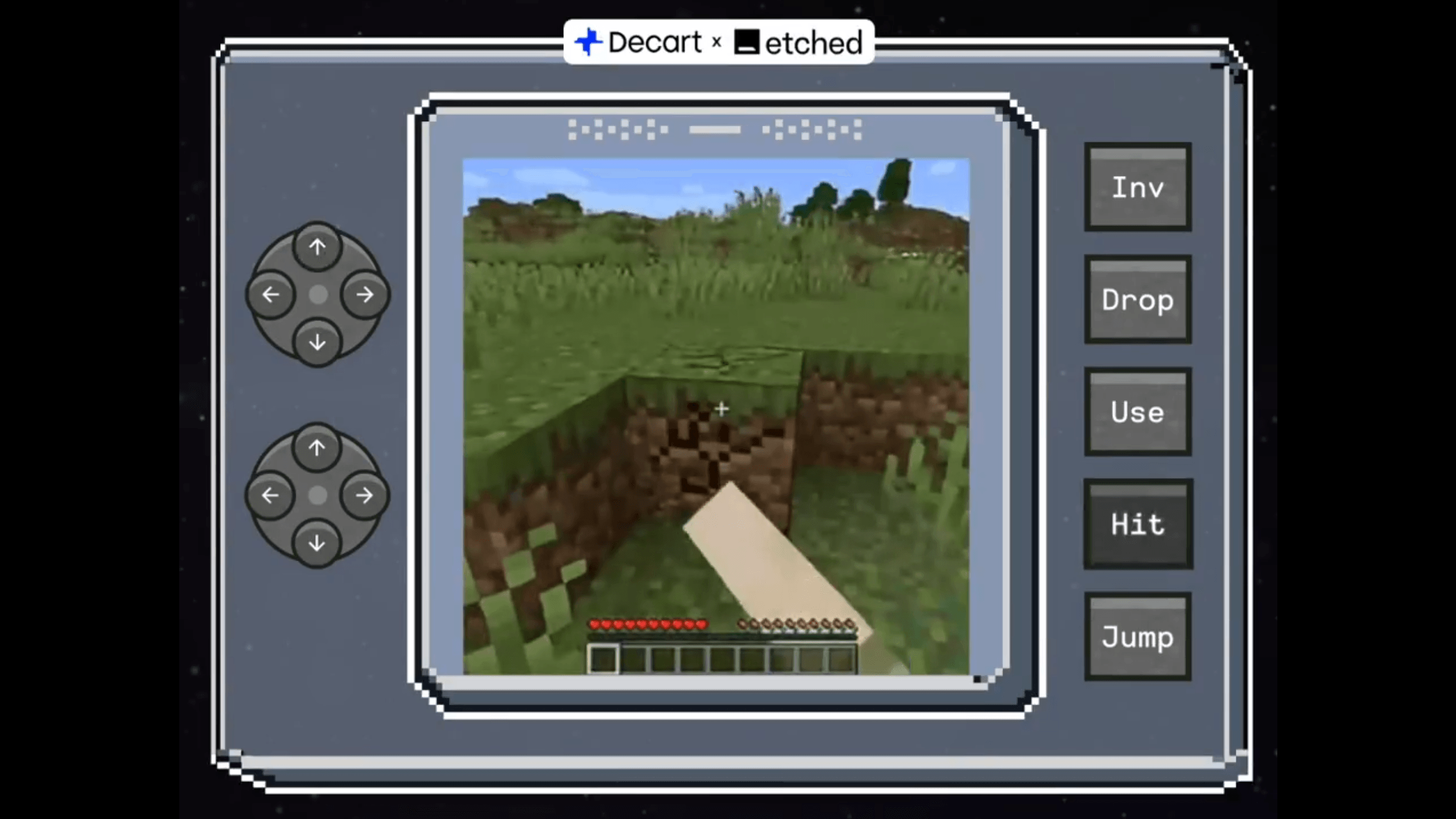
Oasis AI
The world's first playable AI-generated game, Oasis reimagines Minecraft entirely through real-time AI generation. Unlike traditional games, there's no code or game engine—every frame is generated by AI using "next-frame prediction" trained on millions of hours of Minecraft footage.
What Makes It Special: Oasis runs entirely in your browser with no downloads required. It generates gameplay 100x faster than typical text-to-video models, making real-time interaction possible. The experience is dreamlike and unpredictable—landscapes morph, inventory items transform, creating a surreal gaming experience.
Limitations: Limited memory means worlds don't stay consistent long-term. Graphics quality varies, and the "dream-like" quality can break immersion. Best viewed as a groundbreaking proof of concept rather than a polished game.
Play Oasis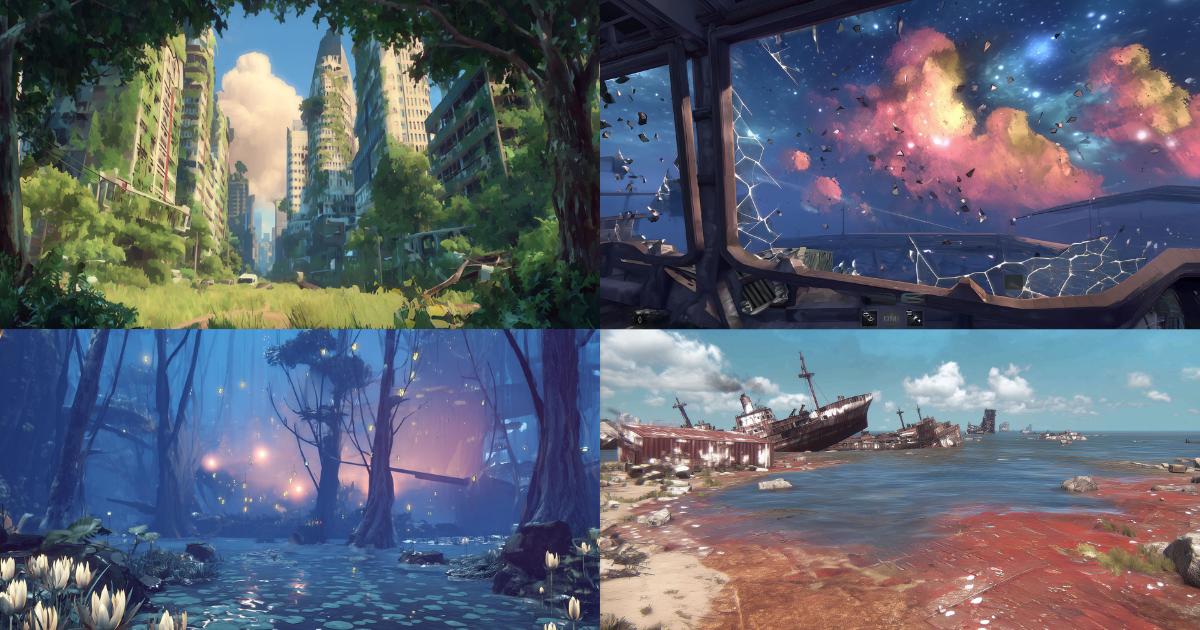
Waypoint-1.5 / Waypoint 2 (Overworld)
A real-time diffusion world model built to run on the hardware people already own. Unlike models that require cloud GPU clusters, Overworld's Waypoint line runs entirely locally, delivering game-level frame rates without server latency or data leaving your machine.
The Innovation: Waypoint-1.5 is Overworld's second major release, trained on roughly 100x more data than the original Waypoint-1. It ships in two tiers — a 720p model for higher-end GPUs (RTX 3090 through 5090) and a lighter 360p tier for gaming laptops and, soon, Apple Silicon — so more people can run it locally without giving up real-time interactivity.
Why It Matters: Everything runs on-device via the Biome desktop client, or instantly in-browser through Overworld.stream with no GPU required. No data center costs, no unpredictable latency, and creative choices stay on your machine.
Next Up — Waypoint 2: Overworld's new frontier model is now in invite-only beta. It turns a prompt or an image into an explorable world, locally on PC or via streaming, with more visual detail and greater stability as the world unfolds. Alongside it, Overworld is building a game-creation toolset on top of Waypoint 2 that aims to author complete first-person games from a single prompt.
Current Status: Waypoint-1.5 is fully open-sourced under Apache 2.0, with model weights on Hugging Face and an open-source Python library (world_engine) for programmatic use. Waypoint 2 is opening to builders in waves; resolution, frame rate, hardware requirements and licensing have not been published yet.
Try Overworld Join the Waypoint 2 beta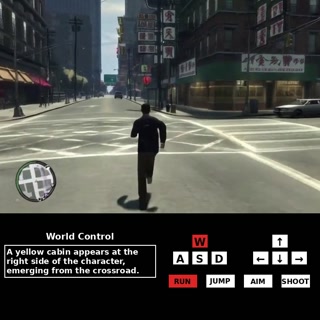
Magica (Apparently Discontinued)
Magica (also known as Mirage 2) is the world's first AI-native UGC (user-generated content) game engine. What sets it apart is the ability to modify worlds on-the-fly using natural language—type "change to cyberpunk city" mid-gameplay and watch the environment transform around you.
Unique Feature: Upload any image—a child's drawing, concept art, or even a Van Gogh painting—and Magica transforms it into a playable environment. This democratizes game creation, letting anyone turn imagination into interactive experiences.
Limitations: Quality can degrade during extended play sessions. Character control is sometimes imperfect, and visual consistency isn't as strong as competitors. However, the rapid development pace (major updates within weeks) shows promise.
Try Magica