
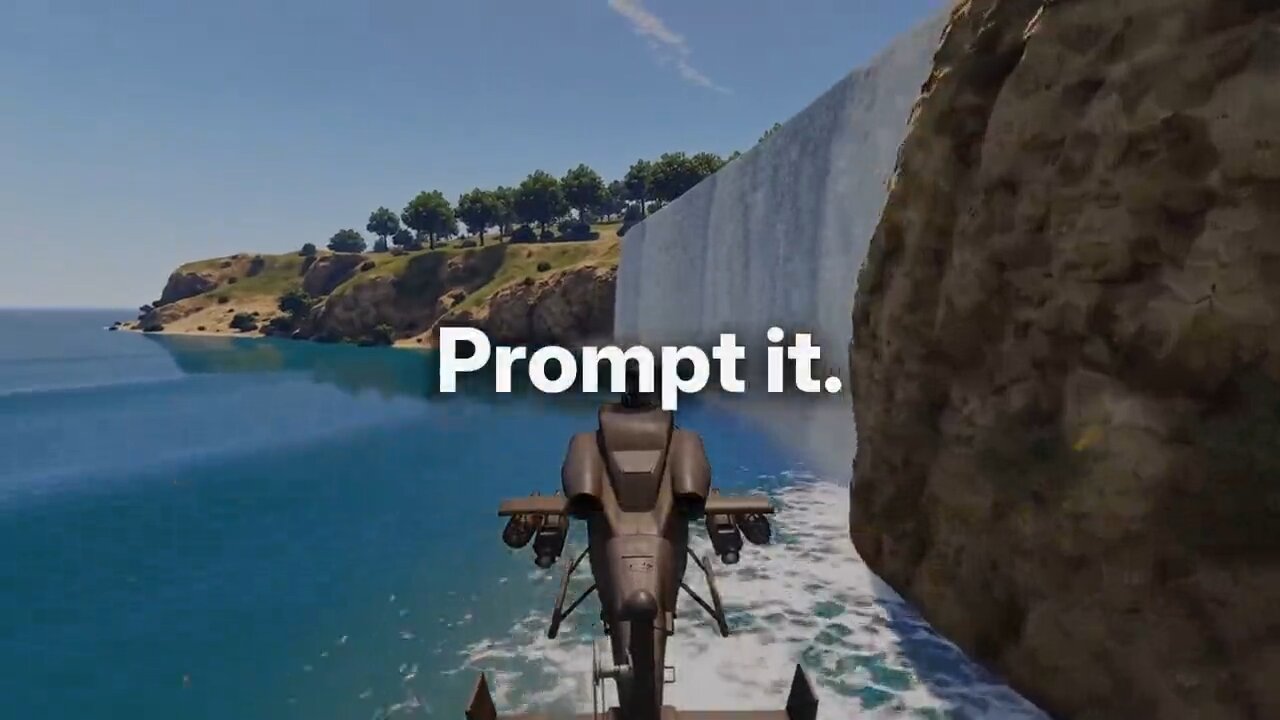
What is Hy-Nomas?
Hy-Nomas is an interactive video world model released by Tencent's Hunyuan team on October 23, 2026. Instead of rendering a single clip from a single prompt, it builds a world one video segment at a time. You start by describing a main character and a place; after every segment you decide what happens next — a new action, a change of weather or art style, an object that appears — or you move the camera, and the model continues the same world from where it stopped.
Tencent calls this free-form interactive world generation. It sits between two families of models: classic text-to-video generators, which produce one fixed shot, and real-time world models such as Genie or ABot-World, which react to every key press. Hy-Nomas trades real-time speed for richer control over what happens in each turn.
How it works
Under the hood, Hy-Nomas is a segment-autoregressive diffusion transformer: 54 dual-stream blocks that process text and video side by side. Text is read by the language part of Qwen2.5-VL-7B, camera paths enter through dedicated cross-attention layers, and a persistent key/value cache carries the history of earlier segments, which is how the forest, room or street stays recognisable as the story moves on. Video is generated in a heavily compressed latent space (32× per side, 4× in time) and turned back into pixels by a separate PixelUMM decoder.
Each turn is described in a structured format that separates three things: one controlled subject with a persistent description, the scene (environment, lighting, other characters and objects), and the subject's actions with start and end times. Later turns only describe what changed. In the official demo you never see this format: a companion model, Nomas-PE, rewrites your plain-language instructions into it automatically.
The released model is distilled to run in 4, 6 or 8 denoising steps per segment, with 8 recommended for best quality and 4 for speed.
Hardware requirements and real-world speed
Tencent ships two configurations. The standard one splits the work across eight GPUs. A low-memory mode runs on a single NVIDIA RTX 4090 by storing the transformer and its cache in INT8, using an FP8 decoder, offloading idle models to system RAM and limiting the history kept on the GPU. That mode needs plenty of system memory: we used a machine with 100 GB of RAM.
We ran the low-memory mode ourselves on a rented RTX 4090. At 480×832 with 4 denoising steps, the transformer generated a 5-second segment in about 7 seconds — but each 4-second turn took around 40 seconds end to end, because the 24 GB card keeps moving the 16 GB text encoder and the large decoder in and out of memory. For comparison, the official Hugging Face demo, running on a 96 GB RTX PRO 6000 Blackwell, returns a 4-second turn in roughly 15 seconds. Note that the FP8 decoder kernel used on the 4090 is specific to that GPU generation; other cards use the larger BF16 decoder.
Open weights and fine-tuning
Hy-Nomas is one of the most complete open releases in this category. Under the Apache 2.0 license Tencent published the distilled model, an INT8 version for single-GPU use, the non-distilled base model needed for training, the video encoder and decoders, the prompt-rewriting model, inference code, a Diffusers pipeline, and Hy-Nomas-Bench — 280 test cases covering text interaction, camera navigation, mixed control and spatial memory.
Fine-tuning is done with LoRA adapters: you train on the base model, then merge the adapter into the fast distilled model. The repository includes a captioning tool that turns your own videos into training data in the right format, and two example adapters (cinematic and robotic-arm simulation). Be aware that the reference training setup is sized for a multi-GPU cluster, not a desktop card.
How to try Hy-Nomas
The fastest way is the free demo on Hugging Face. Describe your protagonist and your world, choose a camera mode (follow, first person or observer), pick a turn length of 3 to 6 seconds and enter the world. From there, type what happens next or hold W, A, S, D and the arrow keys to steer the camera; you can rewind any turn and download the whole journey as an MP4. The demo runs on ZeroGPU, so session length depends on your Hugging Face quota.
Tips that work well: write in English, keep to one clear action per turn, and refer to people and objects with the same words every time ("the mug", "the man") so the model does not invent new ones. Only one character is directly controlled; describe anyone else as part of the scene.
Strengths and limitations
Strengths
- Rich control: free-form text every turn plus camera paths
- Fully open under Apache 2.0, including the base model and training code
- Official LoRA fine-tuning pipeline and data-captioning tool
- Runs on a single RTX 4090 in low-memory mode
- Free browser demo with rewind and MP4 download
Limitations
- Turn-based, not real-time
- Slow on 24 GB cards (≈40 s per 4-second turn at 480p in our test)
- Only one directly controlled character
- Visual memory on a single GPU is limited to a short window of recent frames
- Reference fine-tuning setup needs a GPU cluster; technical report not yet published
Who is Hy-Nomas for?
Developers and researchers who want an open world model they can run, study and fine-tune; storytellers who prefer directing a scene turn by turn over playing it like a game.
Frequently asked questions
Is Hy-Nomas open source?
Yes. Weights, inference code and training code are released under the Apache 2.0 license, which permits commercial use. Third-party components, such as the Qwen text encoder, keep their own licenses.
Can Hy-Nomas run on an RTX 4090?
Yes. Tencent provides a single-GPU low-memory configuration tested on the RTX 4090, using INT8 weights, an FP8 decoder and CPU offload. It needs a lot of system RAM and is slower than the multi-GPU setup.
Is Hy-Nomas real-time?
No. It generates the world in segments of a few seconds. On the official demo hardware a 4-second turn takes about 15 seconds; in our RTX 4090 test it took about 40 seconds at 480p.
What resolution does Hy-Nomas support?
The default output is 720×1280 at 24 FPS. Lower presets of 480×832 and 352×640 are available and generate faster.
Can I fine-tune Hy-Nomas on my own videos?
Yes, with LoRA. The repository includes a tool that captions your videos into training data, a training configuration that starts from the non-distilled base model, and a script to merge the result into the fast distilled model. The reference setup targets a multi-GPU cluster.
How is Hy-Nomas different from Genie 4?
Genie 4 is Google DeepMind's closed, real-time world model with native audio, available as a research preview. Hy-Nomas is open, runs on your own hardware and can be fine-tuned, but it works turn by turn rather than in real time and has no audio.