
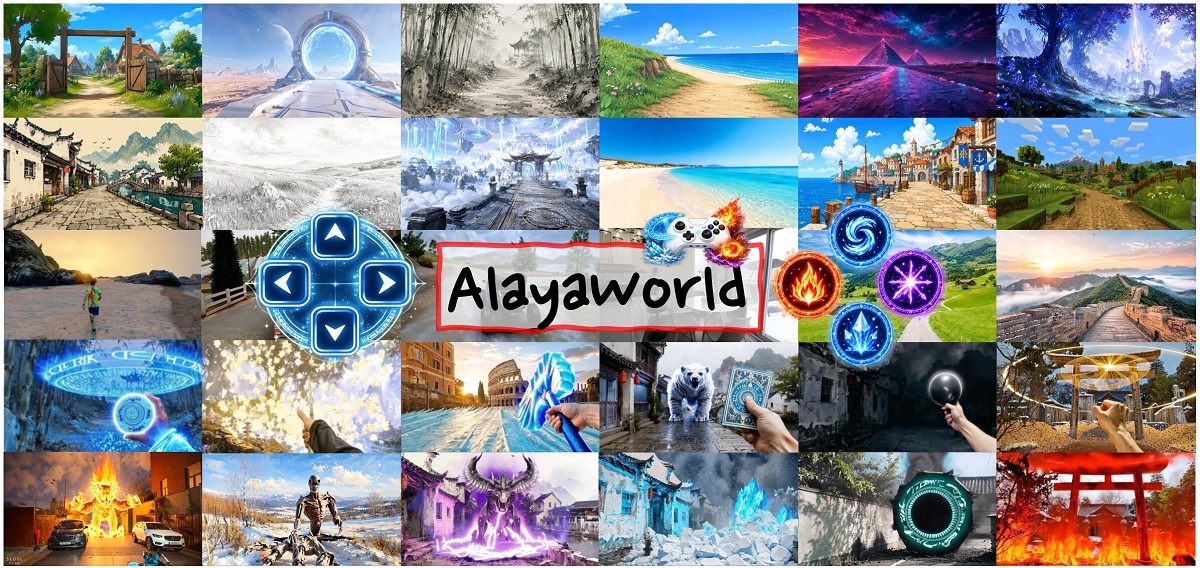
What is AlayaWorld?
AlayaWorld is an open-source interactive world model from Alaya Lab, conceived as a full-stack, long-term project rather than a one-off demo. It is a 15-billion-parameter video diffusion transformer that generates the world in short chunks at 24 FPS, in 540p or 720p, steered by camera movement and by text prompts you can swap mid-session to trigger new events — spell casting, a fight, an object appearing, a scene transforming.
How it remembers
Its defining feature is memory. Rather than relying only on the last few frames, every new chunk is conditioned on four kinds of context: a persistent anchor frame, a compressed summary of older history, a 3D point cache of the scene rendered from the current viewpoint (introduced in version 1.1), and the most recent frames. Walk out of a room and come back, and the layout, textures and objects are where you left them.
Drift — the slow blur, colour shift and geometric decay that ruins long sessions — is tackled during training, by showing the model deliberately corrupted histories and an “error bank” of its own past artifacts. A distillation scheme cuts inference from about 30 sampling steps to four per chunk.
AlayaWorld vs Alaya-EVOKE
AlayaWorld is the base model. Alaya-EVOKE is a follow-up built on top of it that moves scene geometry into an external, camera-indexed world-state bank and reads it back as needed, so the model's own context stays small. Its authors report eight continuous sessions of 65.5 minutes each without visible drift, generating 1.5-second chunks in about 2.1 seconds on a single H200 GPU at 384×640 — slightly slower than real time, on top-tier hardware.
Limitations
By the team's own benchmark, AlayaWorld leads on consistency but is weaker on physical interaction and causal fidelity. In practice it remembers places far better than it tracks what characters are doing or what has happened: people can be added and animated with text, but they have no dedicated long-term memory. At 15B parameters, it is a data-center model, not a desktop one.
Strengths and limitations
Strengths
- Among the strongest scene memory of any open model
- Full-stack open release, including training code
- Text prompts can introduce new events mid-session
- Alaya-EVOKE extends sessions to over an hour
Limitations
- 15B parameters: needs data-center GPUs
- Weaker on physics and cause-and-effect
- Remembers places better than characters or events
- EVOKE runs slightly slower than real time
Who is AlayaWorld for?
Researchers and teams working on long-horizon consistency and world-model memory who want a fully open base with training code.
Frequently asked questions
What is the difference between AlayaWorld and Alaya-EVOKE?
AlayaWorld is the base model. Alaya-EVOKE builds on it with an external, camera-indexed world-state bank, extending coherent sessions to over an hour.
Is AlayaWorld open source?
Yes. Code, weights, training scripts and part of the training data are public.
How long does AlayaWorld remember a scene?
The base model targets minute-long rollouts; Alaya-EVOKE reports continuous 65.5-minute sessions without visible drift.
Can AlayaWorld run on a gaming GPU?
Not comfortably. At 15 billion parameters it is designed for data-center GPUs; EVOKE's published timings use a single H200.